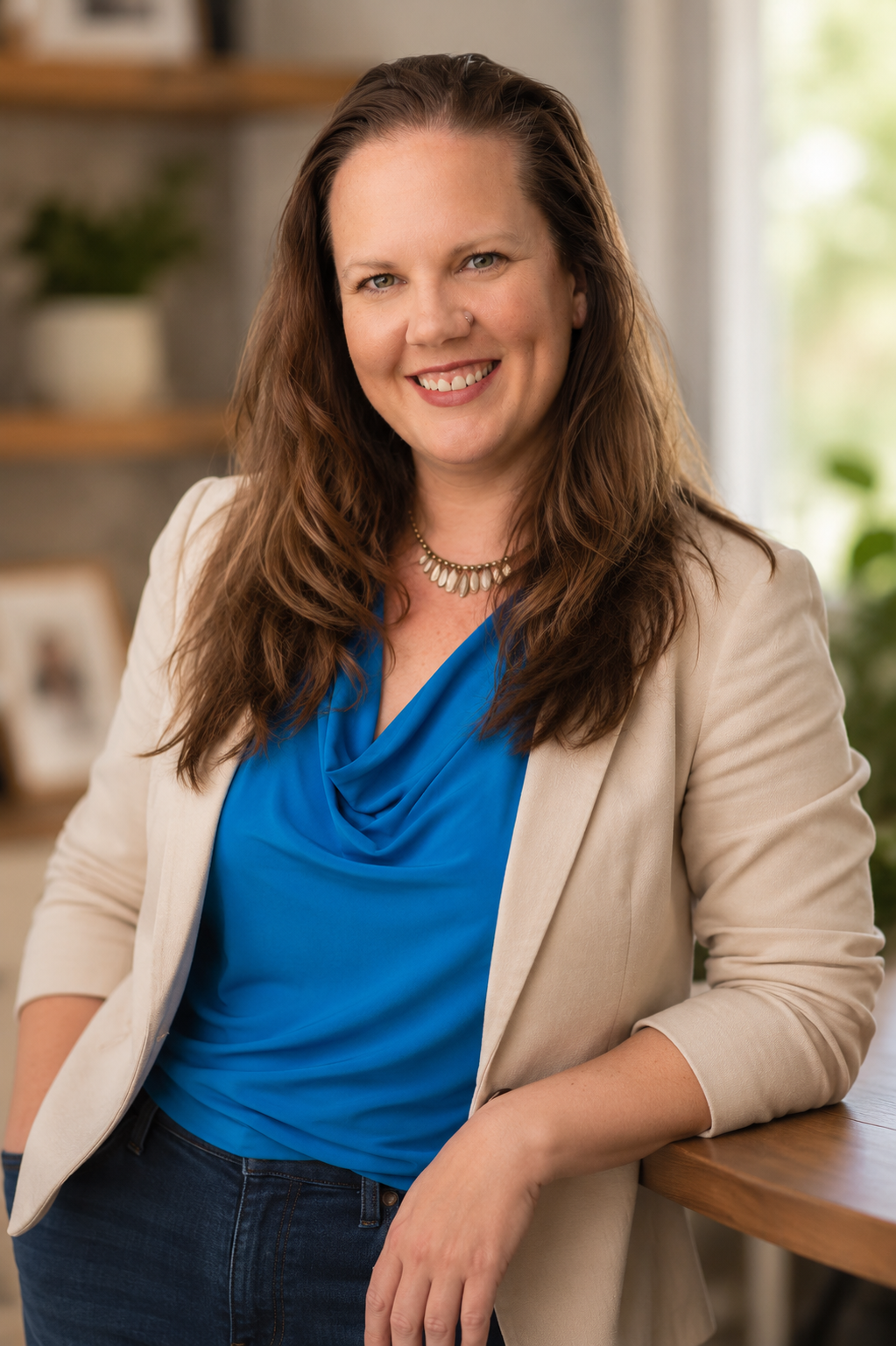
Janel Beidel
LICENSED CLINICAL SOCIAL WORKER
The thing that's bothering you usually isn't the thing that's actually hurting. Let's go find what's underneath — that's the part that heals.
You've been managing this for a long time. I'd rather help you heal it.
Credentials:
Licensed Clinical Social Worker: CSW.09930092
Verify: dora.colorado.gov/check-a-licenseNPI: 190256591
Verify: npiregistry.cms.hhs.gov
Education:
University of Denver Graduate School of Social Work-Denver, CO
Masters of Social Work
https://socialwork.du.edu/
Certifications:
EMDR certified through EMDRIA: https://emdrtherapy.com/
Completed all classes for LAC through: https://familyplaytherapy.net/
Theories of Concentration:
EMDR
CBT/DBT/CPT
Psychodynamic
IFS
Polyvagal
Trauma, ADHD, and How I Work
-
I work with adults, generally 25 and older, who are carrying anxiety, trauma, or the exhausting sense that they keep ending up in the same painful place. Many of my clients are late-diagnosed or newly wondering about ADHD, and are finally putting words to a lifetime of feeling behind, scattered, or "too much." Others come in because their relationships keep echoing something old — a way of loving, or bracing, or disappearing that they learned long before they had any say in it.
Some of my clients are also navigating substance use, and I'm comfortable holding that alongside everything else.
You don't have to arrive knowing what's wrong. Most people don't. You just have to be willing to look.
-
My specialties are anxiety, depression, ADHD, and trauma; and the place where these things might really show up are in your relationships.
I'm not especially interested in managing your symptoms forever. Coping skills matter, and we'll build them, but they're scaffolding, not the repair. What I want is the root: the original wound that taught your nervous system this was necessary. When we heal that, the symptoms have less to hold onto.
To get there I draw on EMDR, parts work, somatic, and polyvagal approaches, CBT, DBT, Cognitive Processing Therapy, and psychodynamic work. Which of those we use depends entirely on you. I work with individuals, in individual sessions.
-
I have always known that I wanted to be a therapist. I chose Social Work over Counseling because it allowed me to test many areas of the field. These experiences have led to my identity and how I practice as an individual therapist.
I've spent over 20 years in this field, and I've come at it from a lot of angles. Prior to this role I was an outpatient therapist where I supervised other therapists, facilitated therapy groups, and assessed clients in crisis.
Before that, I co-founded Bridge of Hope Greater Denver and ran it as Program Director. I taught as an adjunct professor at the University of Denver's Graduate School of Social Work. I spent four years as a policy analyst for the Colorado Department of Human Services, where I was recognized with the Craig R. Goellner Innovation Award for a statewide training tool that's still in use. And well before any of that, I did case management with families in transitional housing.
What that history gave me is range. I've sat with people in genuine crisis and I've sat with people whose lives look fine from the outside and don't feel that way at all. I take both seriously.
I earned my Master of Social Work at the University of Denver, and pretty much everything since has been chosen rather than required. I'm Certified in EMDR, I work from an Internal Family Systems framework, use CBT, DBT, and Cognitive Processing Therapy where structure helps, and draw on somatic and polyvagal approaches for the parts of trauma that talking doesn't reach. Underneath all of it is a psychodynamic conviction that the past is usually still in the room.
I completed all the coursework for my License in Addiction Counseling. What I learned is that in almost every story there is an addiction that plays a part. When we think of addiction we tend to think of alcohol and drugs. When I see addiction I see a much wider range of issues (substances, porn, social media, love, etc.). This education has played a crucial role in how I work with people.
I keep training, and not for the certificates. Our understanding of trauma has changed enormously since I started, and it's going to keep changing. You deserve a therapist who's still curious about that, not one running on what she learned a decade ago.